Flat editorial illustration showing three ascending stair steps rendered in electric blue, rising from left to right, with a bold gold diamond marker resting at the highest step — representing the Alpha tier as a higher elevation in tax-aware portfolio management. Small interlocking blue gears at the base hint at the algorithmic engine that powers the short overlay and margin-aware unwinds. A calm navy horizon line sits above the stairs with soft gold light breaking through, evoking next-tier elevation. Off-white background, restrained and precise.
The Alpha tier builds on the long-only Autopilot foundation by adding a short overlay and margin-aware unwinds — structural tools that may extend the harvest cadence when the long-only sleeve's annual losses have plateaued.

Long-only direct indexing with autonomous execution covers most investors most of the time. Alpha exists for the cases where it doesn't.

The honest pitch: Alpha costs $199/month, double Autopilot. The math has to be there for a specific kind of portfolio — high realized gains, RSU-heavy, concentrated stock, or just enough capital that a 1-2% improvement in tax-alpha matters in absolute dollars. If that's not you, stop reading. Autopilot is the right answer.

The case for Alpha

What specific portfolio situations make the Alpha tier worth its additional cost over Autopilot?

Alpha makes financial sense primarily for investors with high realized gains, RSU-heavy or concentrated-stock positions, portfolios above approximately $500K at 32%+ federal rate, or long-only sleeves where the harvest cadence has plateaued — situations where the short overlay can generate additional realized losses that long-only direct indexing cannot.

1. Long-only runs out of harvests in good years

The mechanic: TLH banks losses by selling losers. In a year where the market is mostly up, fewer positions have unrealized losses worth harvesting. Long-only programs harvest aggressively for the first 2-3 years (the sleeve has plenty of cost-basis variance) then taper off as winners replace losers and the cost basis catches up to market.

The data: a $1M direct-index sleeve typically harvests $40K-$60K of losses in year 1, $25K-$35K in year 2, $10K-$20K in year 3, then plateaus at ~$5K-$15K/year as a "noise" floor. After year 3, you've extracted ~80% of the available tax alpha from a long-only structure.

TYPICAL LONG-ONLY HARVEST BY YEAR $1M direct-index sleeve, illustrative $0 $40K–$60K YEAR 1 $25K–$35K YEAR 2 $10K–$20K YEAR 3 $5K–$15K PLATEAU (YEAR 4+)
A $1M direct-index sleeve typically harvests the most in year 1, with the annual range narrowing each year after as cost basis catches up to market. The gold "plateau" bar marks the noise floor a long-only sleeve often settles into by year 4 — the point where the short overlay's additional loss-generation may start to matter most.

2. The short overlay generates losses without changing exposure

A short position drops in value when the underlying rises. So a long+short pair (say long VOO, short an equal dollar of QQQ) gives you nearly identical net exposure to the long-only equivalent but generates loss-side opportunities on whichever side moves against you. In a year where the market rallies 20%, your short side has 20% unrealized losses you can harvest and replace with a structurally similar short.

This is what the Gotham, Aperio, Parametric structures sell as "tax-aware long-short". The Alpha tier is the same mechanic with the same finance research backing it (Sloan accruals, Pontiff-Woodgate issuance, Beneish M-score, idiosyncratic volatility — all peer-reviewed signals for separating likely-decliners from likely-risers in the bottom-quintile-of-each-sector candidate pool).

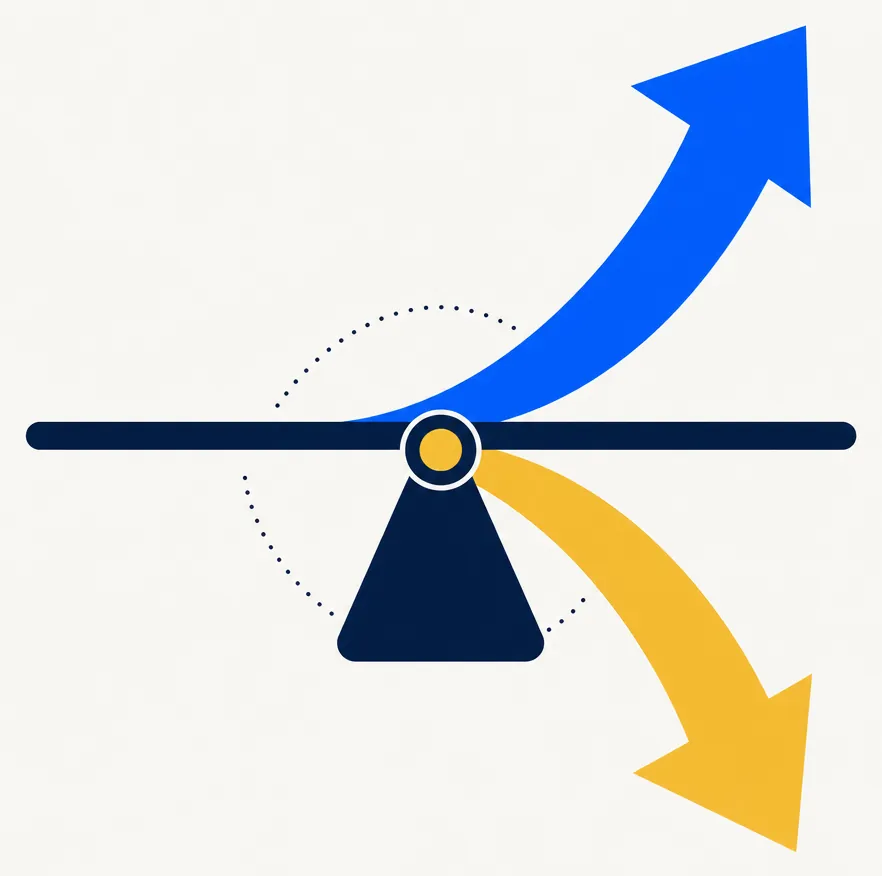
Abstract editorial illustration of a market-neutral long-short pair: a thick electric-blue arrow curves upward while a mirrored gold arrow curves downward, balanced on a slim navy fulcrum at the center, representing offsetting long and short positions that keep net market exposure similar while opening loss-harvesting opportunity on whichever leg moves against the position.
A long-short pair can keep net market exposure roughly similar to the long-only equivalent while opening a loss-harvesting opportunity on whichever leg moves against the position — the mechanic behind the short overlay's added realized losses.

3. Margin trading + concentrated-stock unwind

If you have a single position dominating your portfolio (RSUs that never sold, founder stock, an inheritance), unwinding it without paying massive capital gains is its own engineering problem. Alpha includes:

  • Multi-year tax budget. Set a target gain budget per year (e.g. "stay under $200K of realized LTG so I don't trip NIIT in 2027"). The engine sizes sales against the budget.
  • Margin-aware unwinds. Sell in coordination with margin borrowing so you can rebalance into a diversified sleeve without realizing all the gain in one tax year.
  • Section 1042 / QSBS handling. Founder-stock-specific tax routing for the 10% gain exclusion on Qualified Small Business Stock.

What Alpha doesn't do

What are the honest limitations of the Alpha tier that investors should understand before upgrading?

Alpha does not generate return alpha — the "alpha" in the name refers only to tax alpha — and it requires broker margin approval, which can take 1–3 weeks; the short side also incurs borrow costs that range from approximately 0.25% to 2% annually, which the Alpha cost model factors in explicitly.

Three things to be honest about:

  1. It does not magically generate alpha. The "alpha" in the tier name is tax alpha, not return alpha. Long-short overlays add risk and complexity; they don't add expected return.
  2. It requires margin approval at your broker. Alpha can't short with a cash account. E*TRADE / Schwab / IBKR all need separate margin-account approval. If you're starting fresh, expect 1-3 weeks for the broker to approve.
  3. The short side has costs. Borrow rates run 0.25-2% per year for liquid large-caps, more for hard-to-borrow names. The Alpha cost model (visible in the Risk Engine) bakes this in; the "is it worth it" math depends on your marginal tax rate beating the borrow cost. For 37% federal + 10% state = 47% rate, even 1.5% borrow is a clear win. For 22% federal, the math gets close.
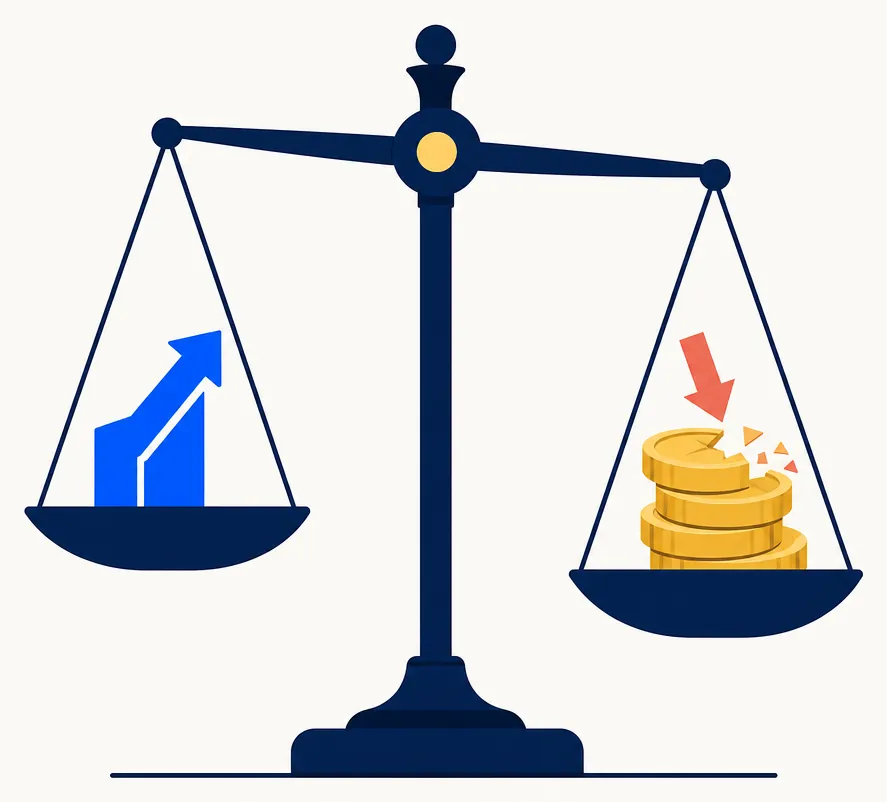
Abstract editorial illustration of a minimal navy balance scale weighing a small blue upward value marker against a stack of gold coin-like tokens with a subtle coral downward arrow chipping at the top coin, representing tax alpha weighed honestly against the short side's borrow cost.
The Alpha tier's benefit is tax alpha only, weighed against a real borrow cost on the short side — the Risk Engine's cost model factors that cost in explicitly rather than presenting the short overlay as a free lunch.

When Alpha is the right answer

What are concrete signals that an investor's situation is well-suited for the Alpha tier?

Concrete indicators include realizing more than approximately $50K of gains in the prior year, holding a portfolio above approximately $500K at a 32%+ federal rate, owning one or more concentrated positions above 20% of taxable assets, or observing that long-only harvest cadence has plateaued after 6+ months on Autopilot.

Concrete signals:

  • You realized $50K+ of gains last year (sale of property, RSU vest, big rebalance). Alpha banks losses to absorb future gains; the bigger the gains, the higher the value.
  • Your portfolio is > $500K and you're at 32%+ federal rate.
  • You have one or more concentrated positions (single-name > 20% of taxable assets) you want to unwind over multiple years.
  • You've been on Autopilot for 6+ months and the harvest cadence has plateaued — you're capturing the long-only floor, but the alpha tier opens up another ~$3K-$15K/year of realized losses on the short side at the typical sleeve size.
Compact four-panel infographic of concrete signals that a portfolio may be well-suited to the Alpha tier. Panel 1, labeled $50K+ GAINS: a tax receipt icon showing a realized gain figure. Panel 2, labeled $500K+ PORTFOLIO: a rising stack of gold coin tokens. Panel 3, labeled 20%+ CONCENTRATED POSITION: a pie chart with one dominant blue slice. Panel 4, labeled CADENCE PLATEAUED: a line chart that rises then flattens into a gold flat line.
Four concrete signals worth checking before upgrading: realized gains above approximately $50K, a portfolio above approximately $500K, a concentrated position above 20% of taxable assets, or a long-only harvest cadence that has plateaued.

When Alpha is the wrong answer

When is the Alpha tier likely to be the wrong choice?

Alpha tends to be the wrong choice for portfolios under approximately $500K, for investors with margin anxiety (short positions add P&L volatility not present in long-only equivalents), or for those at a 22% marginal rate where the tax math on borrow costs becomes thin.

  • You're under the Autopilot threshold (~$500K). Stay on Guided/Autopilot until the long side is producing material harvests; the short side amplifies what's already there, doesn't replace it.
  • You have margin anxiety. Shorting is psychologically harder than long-only — a short that doubles costs you the original size again. The risk engine caps gross exposure but the day-to-day P&L volatility is higher than long-only equivalents.
  • Your tax rate is < 32%. The math gets thinner. At 22% you might still want it, but the case is weaker.
UNDER ~$500K PORTFOLIO Long side isn't yet producing material harvests MARGIN ANXIETY Short P&L volatility is higher than long-only equivalents BELOW 32% TAX RATE The math on borrow cost versus tax rate gets thinner
Three signals the Alpha tier is likely not a fit yet: a portfolio still under the Autopilot threshold, discomfort with the added P&L volatility of short positions, or a marginal tax rate where the borrow-cost math gets thin.

The graduation path

What is the typical progression from Autopilot to Alpha, and how long does it take?

Most Alpha users first run Autopilot for 6+ months until long-only harvests plateau, then apply for broker margin approval (a 1–3 week process with the broker directly), upgrade to Alpha, and run the short overlay in Shadow mode for approximately 30 days before enabling live execution with per-trade caps.

Most Alpha users come from Autopilot, not from cold sign-ups. The pattern:

  1. Run Autopilot for 6+ months.
  2. Watch the long-only harvest cadence plateau.
  3. Apply for margin approval at your broker. (This is a 1-3 week process you do directly with the broker, not us.)
  4. Upgrade to Alpha in Settings → Billing.
  5. Run the short overlay in Shadow mode for 30 days. The engine will propose what it WOULD have shorted; you watch.
  6. If the shadow proposals look reasonable, flip to Small (per-trade caps) for another 30 days.
  7. Move to Standard once you've seen the cadence on real money.
AUTOPILOT 6+ months until harvest cadence plateaus MARGIN APPROVAL ~1–3 weeks direct with your broker SHADOW MODE ~30 days engine proposes, you watch only SMALL CAPS ~30 days live, per-trade caps in place STANDARD LIVE full cadence after cadence seen on real money
The typical path from Autopilot to Alpha runs roughly six or more months on Autopilot, a broker-side margin approval of about one to three weeks, then a graduated rollout — shadow mode, small per-trade caps, and finally standard live execution — mirroring the same autonomy graduation rails used elsewhere in the product.

The upgrade isn't reversible in mid-year — once you have realized gains and losses split across long + short, downgrading mid-year just means the short side's open positions can't get fresh proposals (they roll until they close). Plan for at least a year on Alpha when you start.

See also: when the short overlay is worth the complexity, concentrated stock and RSU tax planning, and what Autopilot adds before Alpha.